A few years ago, marketing automation meant scheduling emails and setting up simple "if this, then that" workflows. Today it means AI systems that write, test, personalize, and optimize campaigns while you focus on strategy.
AI marketing has moved from experimental tooling to core infrastructure for many teams. Whether you're a marketer, business owner, freelancer, or student, understanding AI marketing automation is now a career and business essential.
This guide covers what's trending right now, which tools and strategies matter, and how to start without wasting budget.
What Is AI Marketing Automation?
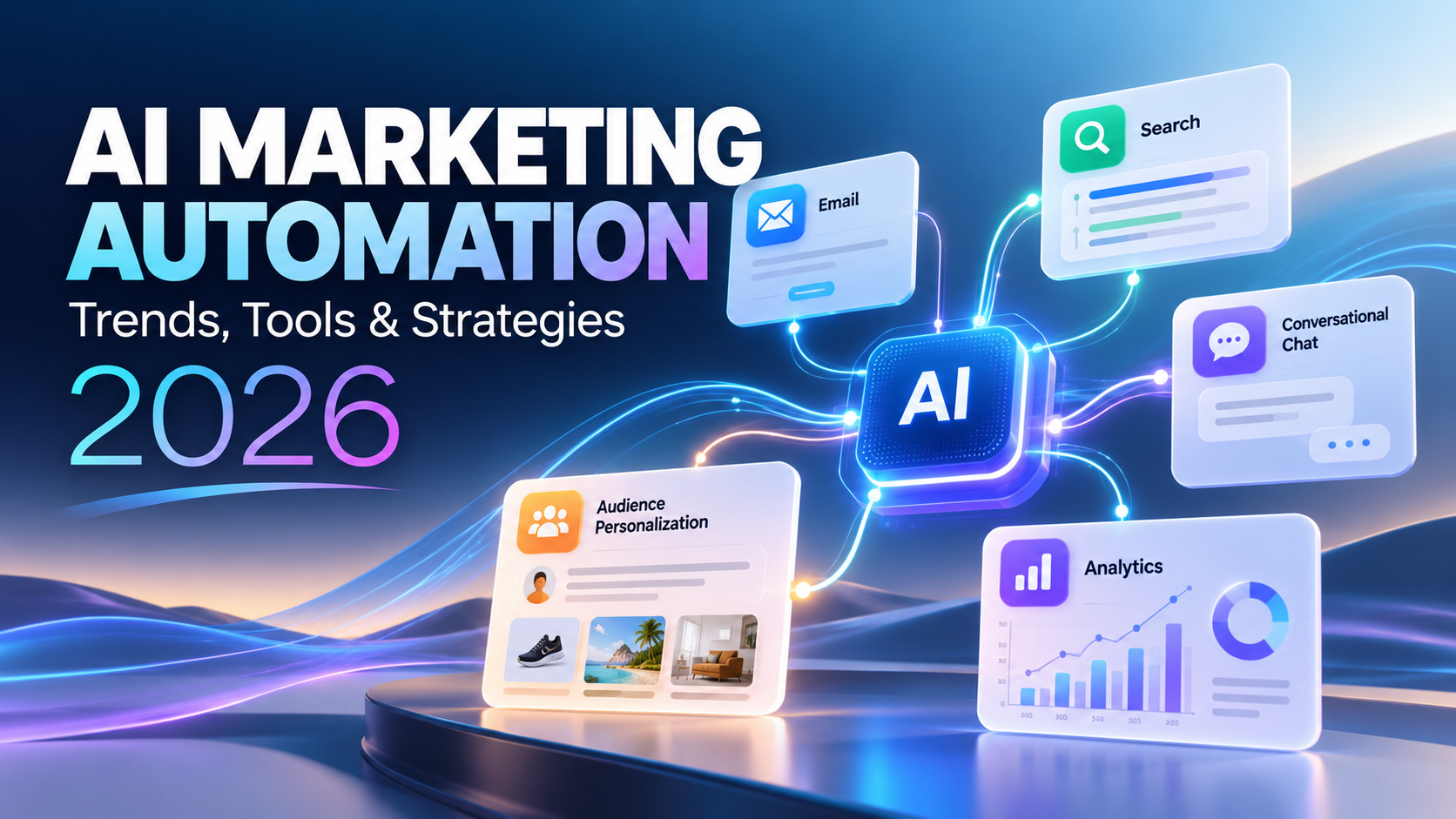
AI marketing automation uses artificial intelligence and machine learning to run, personalize, and improve marketing tasks with minimal manual effort. That includes email sequences, ad optimization, content creation, lead scoring, social media scheduling, chatbots, and reporting.
The key difference from traditional automation is learning. Older systems follow fixed rules. AI-driven systems adapt based on data, so automation is turning from a rules-based approach into a learning-based one.
Top Digital Marketing and AI Automation Trends Right Now
1. AI Agents Are Taking Over Entire Workflows
The biggest shift is from single-task tools to AI agents that handle full workflows from start to finish. Gartner forecasts that 40% of enterprise applications will embed AI agents by the end of 2026, up from under 5% in 2025.
In practice, an agent might research an audience, draft a campaign, launch it, monitor results, and adjust budgets, with a human reviewing key decisions.
How to use it: Start with one agent for one job, such as lead follow-up, weekly reporting, or content repurposing. Expand once it works reliably. To learn how to build agents like these without coding, see our guide to a generative AI automation course. Our round-up of new Claude AI features for marketers shows what agent tools such as Claude Cowork can already do.
2. Self-Optimizing Workflows Replace Fixed Schedules
Marketing teams increasingly expect automation to improve its own results, not just trigger activity. The move is from scheduled workflows to adaptive systems that optimize timing, content, channel, and prioritization using real-time signals.
Example: Instead of sending every subscriber the same email at 10 a.m., the system chooses the best send time, subject line, and offer for each person.
3. Generative Engine Optimization (GEO) and AI Search
Search is changing. People now get answers from ChatGPT, Gemini, Perplexity, and AI Overviews in search results. Generative Engine Optimization (GEO), also called answer engine optimization, focuses on making your brand visible and citable inside those AI-generated answers.
How to use it:
- Write clear, direct answers to common questions
- Use structured headings, FAQs, and schema markup
- Build authority with original data, expert quotes, and consistent brand mentions
- Keep your information accurate and up to date across the web
Traditional SEO still matters, but optimizing only for blue links is no longer enough. For local businesses, accurate business information matters for both AI answers and map results; our local SEO checklist for Dubai covers the essentials.
4. Hyper-Personalization at Scale
Personalization is becoming so seamless that users rarely notice it. AI analyzes behavior in real time to tailor website content, product recommendations, emails, and ads to individuals instead of broad segments.
How to use it: Begin with behavioral triggers (browsing history, cart activity, past purchases), then add predictive recommendations as your data matures. Online stores are a natural place to start, and our guide to e-commerce marketing skills covers personalization, retention and conversion in more depth.
5. Generative AI for Content and Creative
Generative AI now supports copy, images, video, voice-over, and design. Some systems generate platform-specific social posts directly from a URL, press release, or internal document, then keep a consistent schedule with little manual input.
Best practice: Treat AI output as a first draft. Human editing for brand voice, accuracy, and originality is what separates standout content from generic noise.
6. Predictive Analytics as the Intelligence Layer
Predictive models forecast which leads will convert, which customers may churn, and which campaigns will perform best. This lets you shift budget before money is wasted, rather than after.
How to use it: Use predictive lead scoring in your CRM and forecast tools for budget allocation.
7. Conversational AI and Smarter Chatbots
AI chatbots and assistants engage customers around the clock, qualify leads, answer questions, and guide buyers through the journey. When integrated with your CRM, they hand off warm leads to sales with full context.
8. AI-Driven Ad Optimization
AI tools monitor ad performance continuously, flagging underperforming creatives, suggesting budget shifts, and highlighting scaling opportunities. This reduces wasted spend and the time marketers spend checking dashboards.
9. First-Party Data and Privacy-First Marketing
With stricter privacy rules and the decline of third-party cookies, first-party data (information customers share directly with you) has become the foundation of effective AI marketing. Poor data quality means poor AI output, so clean data comes before advanced automation.
10. Trust, Transparency, and Ethical AI
As AI takes on more marketing decisions, brands are increasingly expected to deliver performance and explain how their AI-driven strategies work. Disclose AI use where appropriate, protect customer data, check outputs for bias, and avoid misleading content.
11. Natural Language Interfaces
Instead of navigating complex dashboards, marketers increasingly direct AI systems through conversation: "Show me which campaigns underperformed last month and suggest fixes." This lowers the technical barrier and speeds up decision-making.
Popular Types of AI Marketing Tools
| Category | What it does | Example use |
|---|---|---|
| Generative AI assistants | Drafting, research, ideation | Blog outlines, ad copy variations |
| Automation platforms | Connect apps and trigger workflows | Lead capture to CRM to email sequence |
| Marketing automation suites | Email, SMS, segmentation, journeys | Personalized nurture campaigns |
| AI design and video tools | Images, video, voice-over | Social creatives, product videos |
| Ad optimization tools | Budget and creative decisions | Automated bid and budget adjustments |
| Analytics and reporting AI | Insights and forecasting | Automated weekly performance summaries |
| Chatbots and conversational AI | Customer engagement | 24/7 lead qualification |
Tools change quickly, so choose based on your use case, integrations, data privacy, and cost rather than hype.
Benefits of AI Automation in Digital Marketing
- Time savings: Repetitive tasks like reporting, scheduling, and first drafts shrink dramatically
- Better targeting: Data-driven decisions replace guesswork
- Faster testing: Run more experiments in less time
- Scalable personalization: One-to-one messaging without a huge team
- Lower waste: Spot underperforming spend sooner
- Consistent execution: Campaigns keep running while you focus on strategy
Challenges and Risks to Watch
Over-automation. Automating a bad strategy just makes mistakes faster. Automate smarter rather than simply more.
Generic content. If everyone uses the same AI prompts, content starts to look identical. Original insights and a distinct voice are your edge.
Data quality and privacy. AI is only as good as its inputs, and compliance with data laws is non-negotiable.
Hallucinations and errors. AI can produce confident but incorrect information. Always fact-check.
Tool overload. Too many disconnected tools create complexity instead of efficiency.
How to Build an AI Marketing Automation Strategy (Step by Step)
- Set clear goals. Leads, sales, retention, or brand awareness? Pick measurable targets.
- Audit your current process. List repetitive tasks that eat time: reporting, follow-ups, scheduling, content repurposing.
- Clean your data. Organize your CRM, tagging, and tracking before adding AI.
- Start small. Pick one workflow, such as lead nurturing or social content, and automate it well.
- Keep a human in the loop. Review outputs, approve key decisions, and set guardrails.
- Measure and refine. Track conversion rate, cost per lead, response time, and return on ad spend.
- Scale gradually. Once one automation proves ROI, extend to other channels.
Skills Marketers Need in the AI Era
- Prompt engineering: Writing clear instructions to get usable output (our guide to writing AI prompts for marketing shows how)
- Data literacy: Reading analytics and questioning results
- Strategy and creativity: The part AI can't fully replace
- Workflow automation: Connecting tools and building simple automations
- SEO and GEO knowledge: Visibility in both search engines and AI answers
- Ethical judgment: Using AI responsibly
- Core channel expertise: SEO, social, PPC, email, and content still underpin everything
AI won't replace marketers, but marketers who use AI well will likely outperform those who don't. Ongoing learning is the best protection.
Career Opportunities in AI-Powered Digital Marketing
- AI Marketing Specialist
- Marketing Automation Manager
- Digital Marketing Executive
- SEO and GEO Specialist
- Performance Marketing Manager
- Content Strategist (AI-assisted)
- Marketing Analyst
- Freelance Digital Marketing Consultant
In busy markets like the UAE, where e-commerce, real estate, hospitality, and retail compete heavily online, professionals who combine marketing knowledge with AI workflow skills are in a strong position.
For the fundamentals behind these trends, see what is digital marketing: the complete guide.
Frequently Asked Questions
What is the biggest AI marketing trend in 2026?
The shift from scheduled, rules-based automation to AI agents and adaptive systems that plan, execute, and optimize campaigns with human oversight.
Will AI replace digital marketers?
No. It automates tasks, but strategy, creativity, judgment, brand voice, and client relationships still need people. Roles are evolving rather than disappearing.
What is GEO (Generative Engine Optimization)?
GEO is the practice of optimizing your content so AI tools like ChatGPT, Gemini, and Perplexity can find, understand, and cite your brand in their answers.
Is AI marketing automation suitable for small businesses?
Yes. Start with affordable tools for email, content, chatbots, and reporting, and expand as results come in.
What should I automate first?
Repetitive, rules-based tasks: lead follow-up emails, social scheduling, report generation, and content repurposing.
Do I need coding skills?
Not necessarily. Many automation and AI tools are no-code or low-code.
Final Thoughts
Digital marketing and AI automation are now inseparable. The winners in 2026 won't be the teams with the most tools, but the ones with clean data, clear strategy, smart workflows, and human judgment guiding the AI.
Start small, measure results, and keep learning. The marketers who build AI skills now will be well positioned as automation becomes standard.
Ready to build job-ready skills? Explore the Certified Digital Marketing Master with Generative AI program that combines core channels with generative AI and automation, and start applying these trends to real projects.