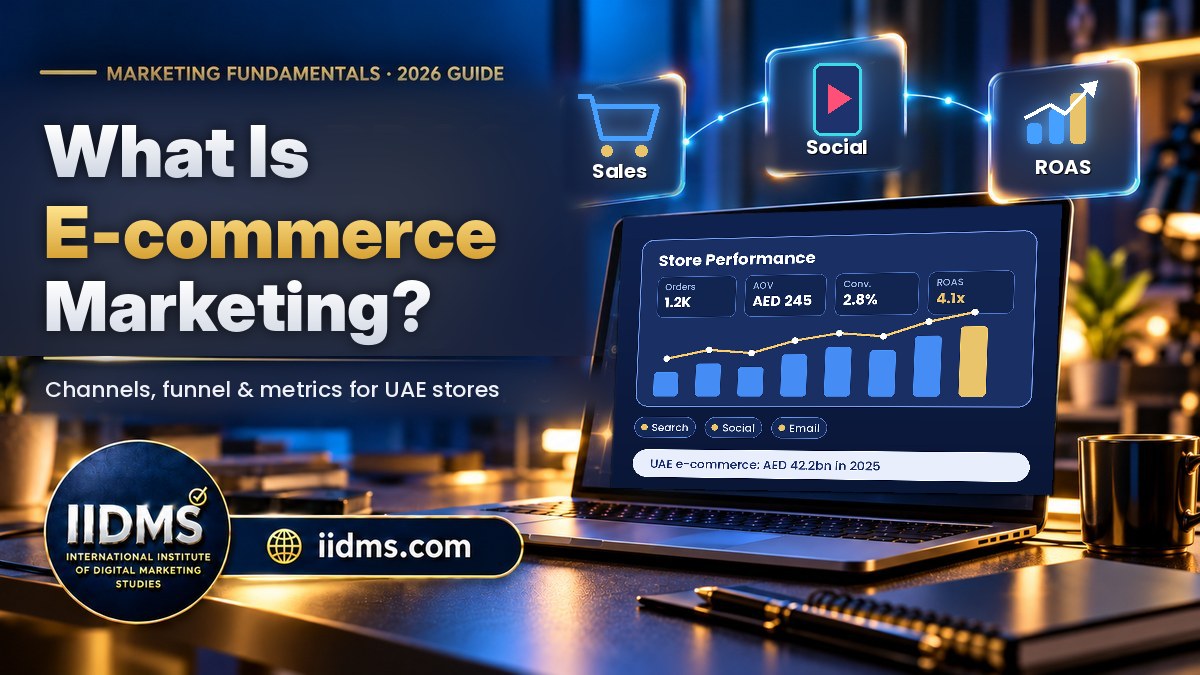
Online shopping is now a normal part of life in the UAE, and the businesses that win online are the ones that market their stores well, not just the ones with the best products. This beginner's guide explains what e-commerce marketing is, the main channels, the sales funnel, the metrics that matter and a practical plan for UAE businesses in 2026.
It is part of our marketing fundamentals series. For the bigger picture, read what is digital marketing: the complete guide.
E-commerce in the UAE: The Key Numbers
A 2026 report by EZDubai Logistics Hub with Euromonitor International shows how fast the market is growing (1).
| Measure | Figure |
|---|---|
| UAE e-commerce market size, 2025 | AED 42.2 billion (about USD 11.5 billion) |
| Annual growth, 2020 to 2025 | 19% CAGR |
| Share of total retail sales, 2025 | About 15.7% |
| Forecast for 2030 | About AED 67.2 billion |
| Largest category, 2025 | Apparel and footwear (AED 11.4 billion) |
The same report highlights AI-driven personalisation, fast delivery, social commerce and digital wallets as key trends (1). With most web traffic now coming from phones, a mobile-friendly store is essential. Read our guide to mobile marketing.
The Main E-commerce Marketing Channels
| Channel | Role in the funnel | Example |
|---|---|---|
| SEO | Attracts shoppers searching for products | Optimised category and product pages |
| Paid search and shopping ads | Captures buyers ready to purchase | Google Shopping and Performance Max campaigns |
| Social media and social commerce | Creates demand and discovery | Instagram and TikTok videos with product tags |
| Email and messaging | Brings shoppers back and builds loyalty | Abandoned cart emails and WhatsApp updates |
| Marketplaces | Reaches customers where they already shop | Listing products on major regional marketplaces |
| Affiliates and creators | Extends reach through trusted voices | Commission-based partnerships; see what is affiliate marketing |
The E-commerce Marketing Funnel
- Awareness: people discover your brand through social media, video, creators or search.
- Consideration: they compare products, read reviews and visit your store.
- Purchase: a clear product page, trusted payment options and fast delivery turn interest into sales.
- Retention: email, loyalty offers and great service bring customers back.
- Advocacy: happy customers leave reviews and recommend you.
A Practical Plan for UAE Online Stores
Step 1: Optimise your product pages
Use clear titles, helpful descriptions, high-quality images, prices in AED, delivery times and return information. Product pages are your most important sales assets.
Step 2: Build search visibility
Optimise category pages for the terms shoppers use and fix technical issues. Our beginner's guide to SEO explains the basics.
Step 3: Use paid campaigns wisely
Start with shopping and search campaigns for high-intent buyers, then add social ads for discovery. Read what is PPC advertising and Google Ads vs Meta Ads.
Step 4: Create social content that sells
Short videos showing products in use, unboxings and customer stories perform well. Our social media marketing guide shows how to plan it.
Step 5: Recover abandoned carts
Send a reminder email or message within a few hours, and keep checkout short with popular payment options.
Step 6: Grow repeat purchases
Use email, loyalty rewards and personalised recommendations. Our email marketing guide explains how.
Key E-commerce Metrics
| Metric | What it tells you |
|---|---|
| Conversion rate | The share of visitors who buy |
| Average order value (AOV) | How much each customer spends per order |
| Return on ad spend (ROAS) | Revenue earned for each dirham spent on ads |
| Cart abandonment rate | How many shoppers leave before paying |
| Customer lifetime value (CLV) | The total revenue a customer brings over time |
| Repeat purchase rate | How many customers come back |
Track these with enhanced e-commerce reporting in Google Analytics 4; our GA4 guide explains the setup.
Common Mistakes to Avoid
- Weak product pages. Poor images and thin descriptions lose sales.
- Hidden delivery costs. Surprises at checkout cause abandoned carts.
- Relying on one channel. Combine search, social, email and marketplaces.
- Measuring clicks instead of profit. Track ROAS, margins and repeat purchases.
- Ignoring mobile shoppers. Test your store and checkout on a phone.
Skills You Need and How to Learn
| Your goal | Suggested course |
|---|---|
| Market and grow an online store | Certified E-Commerce Marketing Professional |
| Run shopping and search campaigns | Certified Pay-Per-Click (PPC) Advertising |
| Build email and retention programmes | Certified Email Marketing Professional |
Learn more about the programme in our article on the Certified E-Commerce Marketing Professional course, or browse all IIDMS courses.
Frequently Asked Questions
What is e-commerce marketing in simple words?
It is the work of bringing shoppers to an online store, persuading them to buy and encouraging them to return, using channels such as search, social media, ads and email.
Which channel is best for a new online store in the UAE?
Most new stores combine search and shopping ads for ready buyers with social media for discovery, then add email to drive repeat purchases.
Is it better to sell on a marketplace or my own website?
Marketplaces give quick access to shoppers; your own website gives you control, customer data and better margins. Many businesses use both.
How long does e-commerce marketing take to work?
Paid campaigns can bring sales within days, while SEO and loyalty programmes build results over several months.
Can I learn e-commerce marketing online?
Yes. Practical online courses cover store optimisation, ads, email and analytics, often with projects you can apply to a real store.
Final Thoughts
E-commerce in the UAE is growing fast, and competition is growing with it. Strong product pages, a mix of search, social and email, and close attention to conversion rate and repeat purchases are what separate profitable stores from the rest.
Ready to grow an online store? Explore the Certified E-Commerce Marketing Professional programme or speak to our admissions team.
Sources
- (1) Gulf Today (WAM), "UAE e-commerce market size reaches Dhs42.2 billion in 2025", reporting the EZDubai Logistics Hub and Euromonitor International e-commerce report (28 September 2026): gulftoday.ae