Pay-per-click advertising is the fastest way to put your business in front of people who are ready to act. You can launch a campaign today and receive enquiries tomorrow, with full control over budget and targeting. This guide explains what PPC is, how ad auctions work, the main platforms and campaign types, how to set a budget, the metrics that matter, how AI is changing PPC in 2026, and a step-by-step plan for your first campaign.
It is part of our marketing fundamentals series. For the bigger picture, read what is digital marketing: the complete guide.
PPC in 2026: The Key Numbers
| Finding | Figure | Source |
|---|---|---|
| Global advertising spend forecast for 2026 | $1.06 trillion (+5.0%) | dentsu, May 2026 |
| Digital share of total ad spend | 69% | dentsu, May 2026 |
| Search advertising growth in 2026 | +3.4% | dentsu, May 2026 |
| Average search ad click-through rate (all industries) | 6.64% | WordStream / LocaliQ 2026 benchmarks |
| Average cost per click (all industries) | $5.42 | WordStream / LocaliQ 2026 |
| Average conversion rate (all industries) | 8.18% | WordStream / LocaliQ 2026 |
| Average cost per lead (all industries) | $66.69 | WordStream / LocaliQ 2026 |
| Education and instruction: CTR / CPC / conversion rate / cost per lead | 7.56% / $4.81 / 13.14% / $77.48 | WordStream / LocaliQ 2026 |
The WordStream figures are medians from 13,474 US search campaigns between April 2025 and March 2026. Costs in the UAE and GCC differ by industry and competition, so use benchmarks as a guide and your own data as the real measure.
How PPC Works: The Ad Auction
Every time someone searches, the platform runs an instant auction to decide which ads appear and in what order. You do not simply win by bidding the most.
- You choose keywords or audiences that match what your customers search for or who they are.
- You set a bid or a bidding strategy, such as maximising conversions or a target cost per acquisition.
- The platform scores your ad. Google calculates Ad Rank from your bid, the quality of your ad and landing page, the expected impact of assets such as sitelinks, and the context of the search.
- The ads with the best Ad Rank appear, and you pay only when someone clicks. Higher quality often means a better position at a lower cost.
| Quality Score factor | What it means | How to improve it |
|---|---|---|
| Expected click-through rate | How likely people are to click your ad | Clear headlines that match the search and include a benefit |
| Ad relevance | How closely the ad matches the keyword's intent | Tight ad groups with closely related keywords |
| Landing page experience | How useful and fast the page is after the click | A focused page that delivers what the ad promised, with a clear form or call button |
The Main PPC Platforms
| Platform | Best for | How targeting works |
|---|---|---|
| Google Ads | Capturing existing demand from people actively searching | Keywords and search intent, plus audiences, locations and AI-powered matching |
| Microsoft Advertising | Extra search reach on Bing, often at lower cost; strong on desktop and B2B | Keywords, plus LinkedIn profile targeting |
| Meta Ads (Facebook and Instagram) | Creating demand, lead forms and retargeting | Interests, behaviours, lookalikes and Advantage+ AI audiences |
| LinkedIn Ads | B2B, corporate training and senior professionals | Job title, industry, company size and seniority |
| YouTube and TikTok Ads | Video reach and awareness among younger and mobile audiences | Interests, keywords, topics and custom audiences |
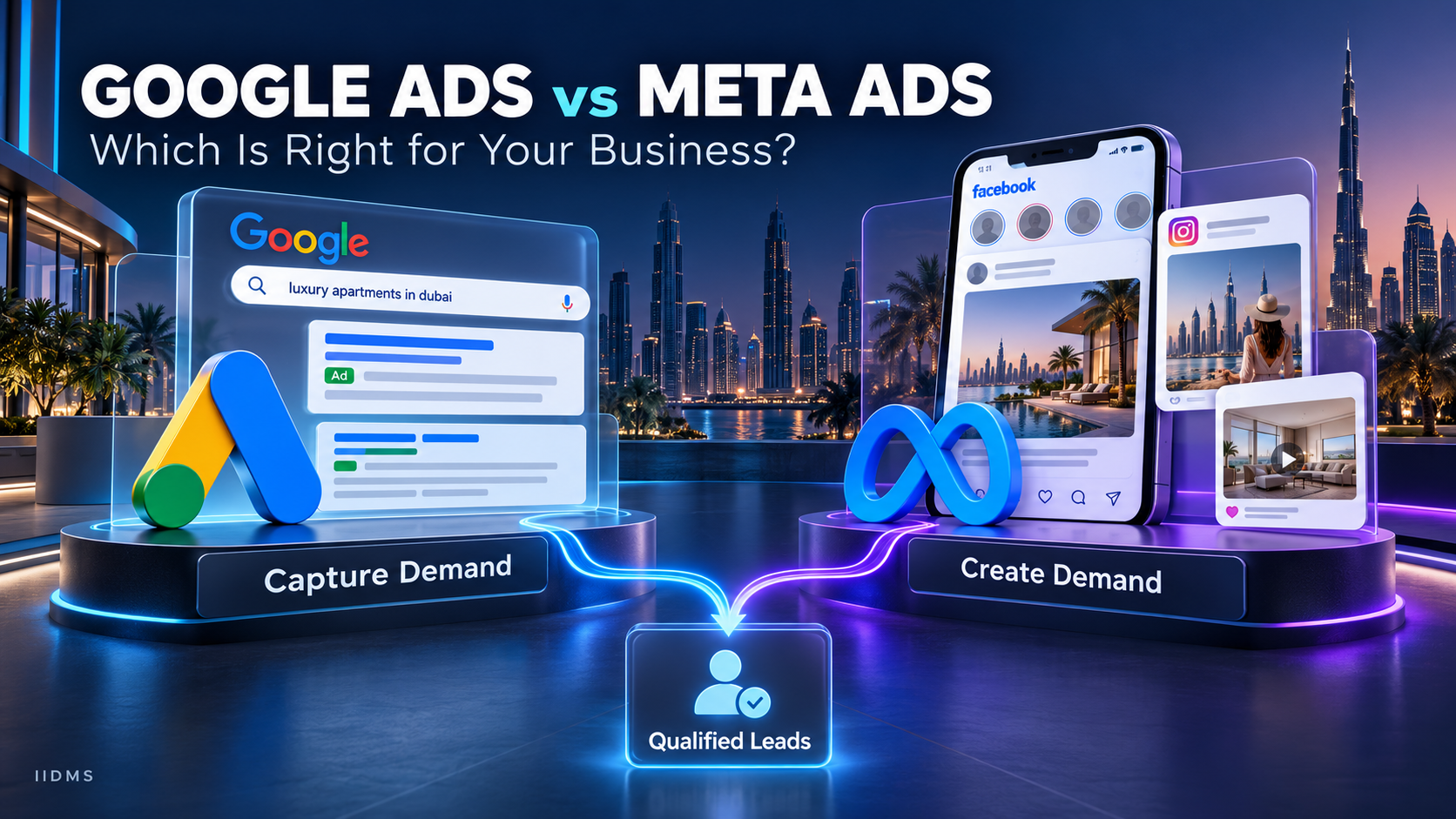
Most businesses start with Google for people already searching and Meta for reaching new audiences. Our Google Ads vs Meta Ads for lead generation post compares them in detail.
Google Ads Campaign Types
| Campaign type | Where ads show | Use it for |
|---|---|---|
| Search (with or without AI Max) | Google search results | Leads and sales from high-intent searches |
| Performance Max | Search, YouTube, Display, Discover, Gmail and Maps from one campaign | Conversions across Google, when you have good tracking and assets |
| Shopping | Product listings with image and price | E-commerce stores using a Merchant Center feed |
| Demand Gen | YouTube, Discover and Gmail | Visual ads that build interest and capture new audiences |
| Video | YouTube | Awareness, consideration and remarketing with video |
| Display | Millions of partner websites and apps | Remarketing and low-cost reach |
Keywords and Match Types
| Match type | Example keyword | Can show for |
|---|---|---|
| Broad match | digital marketing course | Related searches such as "online marketing training Dubai" or "learn social media ads" |
| Phrase match | "digital marketing course" | Searches that include the meaning, such as "best digital marketing course in UAE" |
| Exact match | [digital marketing course] | The same meaning, such as "digital marketing courses" |
| Negative keywords | -free, -jobs | Blocks searches you do not want to pay for |
Broad match works best with smart bidding and accurate conversion tracking. Whatever you choose, check the search terms report every week and add negative keywords. Keyword research skills overlap with SEO, as explained in what is SEO.
How Much Does PPC Cost?
There is no fixed price. You set a daily or monthly budget, and your cost per click depends on competition, quality and targeting. Work backwards from your goal:
| Step | Example (illustrative only) |
|---|---|
| Target leads per month | 50 enquiries |
| Expected landing page conversion rate | 10% |
| Clicks needed | 50 / 10% = 500 clicks |
| Expected cost per click | AED 15 |
| Monthly budget needed | 500 x AED 15 = AED 7,500 |
| Resulting cost per lead | AED 7,500 / 50 = AED 150 |
Then check whether the numbers make sense: if 1 in 10 leads becomes a customer worth AED 5,000, a cost per lead of AED 150 means AED 1,500 in ad cost per sale. Start with a test budget, measure real results and scale what works.
PPC Metrics That Matter
| Metric | Formula | What it tells you |
|---|---|---|
| CTR (click-through rate) | Clicks / impressions | Whether your ad is relevant and appealing |
| CPC (cost per click) | Cost / clicks | How much each visit costs |
| Conversion rate | Conversions / clicks | How well your landing page turns visitors into leads or sales |
| CPL or CPA (cost per lead or acquisition) | Cost / conversions | What each lead or customer costs |
| ROAS (return on ad spend) | Revenue / ad cost | How much revenue each dirham of ads brings back |
| Impression share | Impressions received / impressions available | How much of the available demand you are reaching |
Clicks and cheap leads are not the goal. Track which leads become customers by connecting your ad platforms and Google Analytics 4 to your CRM, and optimise for quality.
How AI Is Changing PPC in 2026
- AI Max for Search. Google describes AI Max as its fastest-growing AI-powered search ads product. It expands matching beyond your keywords and writes ad text using your website and assets. In September 2026, Search campaigns using campaign-level broad match or automatically created assets were moved into AI Max.
- AI Brief. Announced in April 2026, it lets advertisers set messaging, matching and audience guidelines in plain language and preview sample ads before launching.
- More control over where ads run. In October 2026, Google announced channel prioritisation, letting advertisers set priority levels and caps for Search partners and Display.
- Ads in AI search. Ads and shopping listings increasingly appear around AI Overviews and AI Mode, and good landing pages also help your organic visibility in AI answers, as covered in our GEO guide.
- Meta Advantage+. Meta's AI tools automate audiences, placements and creative variations.
AI makes campaigns faster to build, but it optimises for whatever you tell it to. Accurate conversion tracking, clear guidelines, strong creative and human review matter more than ever. See our responsible generative AI workflow.
How to Launch Your First PPC Campaign
- Set one clear goal, such as course enquiries, calls or online sales, and a target cost per lead.
- Set up tracking first: conversion tracking in Google Ads, key events in GA4, the Meta pixel or Conversions API, and lead capture in your CRM.
- Research keywords and audiences, grouping keywords by theme and preparing a negative keyword list.
- Build a focused landing page for each offer, with a clear headline, proof, a short form and a WhatsApp or call option.
- Write ads that match the search with benefits, proof and a clear call to action. Add sitelinks, callouts and images.
- Choose a bidding strategy: start with Maximise Clicks or Maximise Conversions, then move to target CPA once you have enough conversions.
- Launch with a test budget and avoid big changes in the first one to two weeks while the system learns.
- Optimise weekly: review search terms, add negatives, pause weak ads, test new creative and shift budget to what produces quality leads.
Common PPC Mistakes to Avoid
- Launching without conversion tracking.
- Sending all ads to the home page instead of a focused landing page.
- Never checking the search terms report or adding negative keywords.
- Targeting too wide a location or the wrong language.
- Optimising for cheap leads instead of leads that become customers.
- Changing bids and budgets every day before the algorithm has learned.
- Leaving automated features on without reviewing what they show and where.
How to Learn PPC Advertising
PPC is a highly employable skill because every business that advertises online needs it. It is learned best by building and managing real campaigns, reading the data and improving results. IIDMS programmes are available live online or as self-paced study for learners across the UAE and GCC.
| Your goal | Programme |
|---|---|
| Specialise in Google and Meta advertising | Certified Pay-Per-Click (PPC) Advertising |
| Learn every channel, including paid ads, with AI | Certified Digital Marketing Master with Generative AI |
| Run paid social campaigns | Certified Social Media Marketing Professional |
| Advertise an online store with Shopping and Performance Max | Certified E-Commerce Marketing Professional |
Wondering whether a certificate will help your career? Read is a digital marketing certification worth it.
Frequently Asked Questions
What is the difference between PPC and SEO?
PPC is paid: you get immediate visibility and pay for each click. SEO is earned: it takes longer but brings ongoing traffic without paying per click. Most businesses use both.
How much should a small business spend on PPC?
Start with a test budget large enough to get meaningful data, often enough for at least 100 to 200 clicks a month, then scale based on your cost per lead and sales.
How quickly does PPC work?
Ads can show within hours of approval. Smart bidding usually needs one to two weeks and some conversions to learn, so judge results after the first month.
Is Google Ads or Meta Ads better?
Google is better for capturing people already searching, while Meta is better for creating demand and generating leads from a wider audience. Many businesses use both.
Do I need an agency to run PPC?
No. Many businesses run their own campaigns after training. An agency or specialist helps when budgets are large or campaigns are complex.
Can AI run my PPC campaigns for me?
AI handles bidding, matching and ad variations, but people still need to set goals, provide accurate tracking, write guidelines, review search terms and judge lead quality.
Final Thoughts
PPC gives you fast, measurable and controllable growth. Start with one clear goal, accurate tracking and a focused landing page, then let data guide your budget. AI is making campaigns easier to build, but the advertisers who win are still the ones who understand their customers, measure real results and keep optimising.
Ready to run profitable ad campaigns? Explore the Certified Pay-Per-Click (PPC) Advertising programme or speak to our admissions team.
Sources
- WordStream and LocaliQ, "Google Ads Benchmarks 2026" (13,474 US search campaigns, April 2025 to March 2026): wordstream.com
- dentsu, "Ad spend growth is projected to slow to 5.0% in 2026" (May 2026): dentsu.com
- Google, "Steer performance with new AI Max features" (30 April 2026): blog.google
- Bavian, "What changed in Google Ads, September to mid-October 2026": bavian.com