
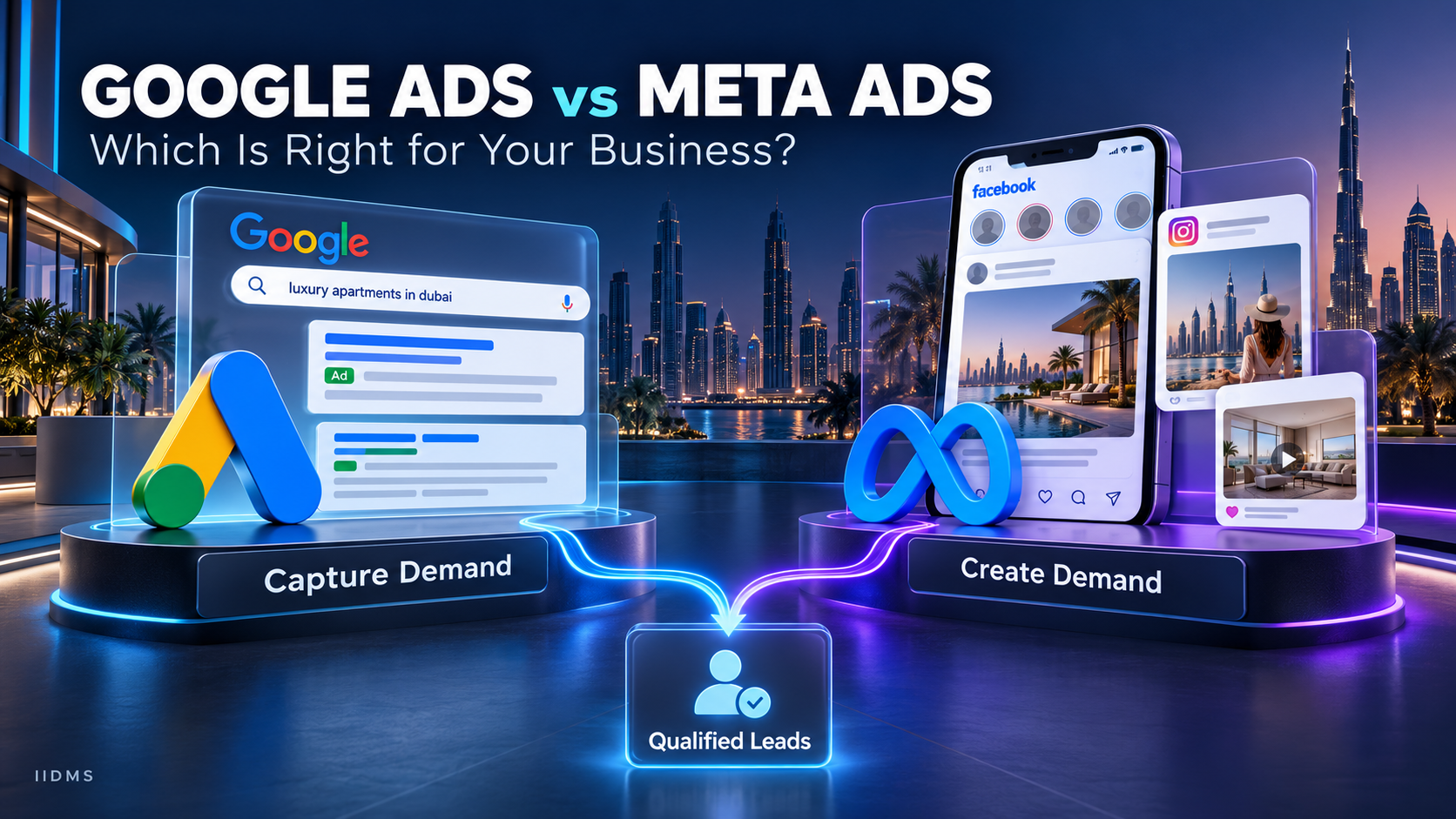
"Should we run Google Ads or Meta Ads?" is one of the most common questions businesses in Dubai and across the UAE ask. The honest answer is that they do different jobs. Google Ads captures demand that already exists. Meta Ads (Facebook and Instagram) creates demand among people who are not searching yet. Knowing the difference, and the numbers behind it, helps you spend your lead generation budget far more wisely.
The Core Difference: Intent
Google Ads (Search) shows your ad to people actively searching for something, for example "digital marketing course Dubai" or "dentist near me". You are capturing existing demand at the moment of need.
Meta Ads show your ad to people based on their interests, behaviour, location and demographics while they scroll Facebook and Instagram. You are interrupting, so your creative has to earn attention and create the demand.
That single difference explains most of what follows: why Google clicks cost more, why Meta leads are cheaper, and why lead quality must be measured carefully on both.
The Data: Google Ads vs Meta Ads Benchmarks
The most widely cited benchmarks come from WordStream by LocaliQ, which analyses thousands of campaigns each year. The figures are medians from US campaigns, so UAE costs will differ, but the relationship between the two platforms is consistent and useful for planning.
| Metric (all-industry average) | Google Ads (Search) | Meta Ads (Leads campaigns) |
|---|---|---|
| Click-through rate (CTR) | 6.66% | 2.59% |
| Cost per click (CPC) | $5.26 (up 12.88% year on year) | $1.92 (up 2.13%) |
| Conversion rate | 7.52% | 7.72% |
| Cost per lead (CPL) | $70.11 (up 5.13%) | $27.66 (up 20.94%) |
| Data period | April 2024 – March 2025, 16,000+ campaigns | April 2024 – June 2025 |
What the numbers tell you
- Meta leads are cheaper on paper. The average Meta lead cost about 60% less than a Google Search lead. That makes Meta attractive for volume and for testing offers.
- Google clicks cost more because intent is higher. Someone searching for your service is often ready to enquire now, which is why advertisers bid more for those clicks.
- Meta costs are rising faster. Meta's cost per lead rose almost 21% in a year, compared with about 5% on Google. Meta's own results show the same pressure: average price per ad rose 12% year on year in Q2 2026.
- Cheap is not the same as profitable. A $28 lead that never answers the phone is more expensive than a $70 lead that becomes a customer. Always compare cost per qualified lead and cost per customer.
Reach: Who You Can Find on Each Platform in the UAE
| Indicator | Figure | Source |
|---|---|---|
| Google's share of search in the UAE | 93.47% (Bing 3.96%), September 2026 | StatCounter |
| People using Meta's apps every day, worldwide | 3.60 billion daily active people, June 2026 | Meta Q2 2026 results |
| UAE social media user identities | 11.3 million, equivalent to the whole population (early 2025) | DataReportal / Kepios |
| UAE internet penetration | 99% (early 2025) | DataReportal / Kepios |
In practice, almost everyone in the UAE who searches does so on Google, and almost everyone is on social media. Both platforms can reach your audience; the question is when in their buying journey you want to meet them.
Head-to-Head Comparison
| Factor | Google Ads | Meta Ads |
|---|---|---|
| User intent | High: people are actively searching | Lower: people are browsing and discovering |
| Targeting | Keywords, location, device, audiences | Interests, behaviours, demographics, lookalikes, location |
| Ad formats | Text search ads, Performance Max, YouTube, Display | Image, video, Reels, Stories, carousel, instant forms |
| Typical cost per click | Higher | Lower |
| Lead quality | Usually higher intent | Varies; needs strong qualifying questions |
| Creative needs | Clear copy and a relevant landing page | Scroll-stopping visuals and video, refreshed often |
| Best for | Services people search for, urgent needs, high-value enquiries | New offers, visual products, awareness, events, retargeting |
| Common pitfall | Broad keywords wasting budget on irrelevant searches | Cheap but unqualified leads from instant forms |
Which Platform Fits Your Business?
| Business type | Lead with | Why |
|---|---|---|
| Clinics, legal, repairs and other urgent local services | Google Ads | People search when they need help now; pair with a strong Google Business Profile and local SEO |
| Training institutes and courses | Both | Google captures "course + city" searches; Meta builds awareness and retargets visitors |
| Real estate | Both | Meta for visual listings and audience reach; Google for buyers searching specific areas |
| E-commerce and fashion | Meta Ads, then Google Shopping | Visual discovery drives first sales; search captures repeat and branded demand (see our e-commerce marketing guide) |
| B2B services | Google Ads (plus LinkedIn) | Decision-makers search for solutions; Meta works mainly for retargeting |
| New product or category nobody searches for yet | Meta Ads | There is no search demand to capture, so you need to create it |
Using Both Together: A Full-Funnel Setup
For many businesses, the strongest setup combines them. Meta builds awareness and fills the top of the funnel. Google captures people when they later search for your brand or service. Retargeting on both platforms brings back people who visited your website but did not enquire.
| Funnel stage | Meta Ads role | Google Ads role |
|---|---|---|
| Awareness | Video and Reels to new audiences | YouTube and Demand Gen (optional) |
| Consideration | Engagement and traffic to helpful content | Search ads on problem and comparison keywords |
| Conversion | Lead forms with qualifying questions | Search ads on high-intent and brand keywords |
| Retargeting | Website visitors and video viewers | Remarketing lists for search and display |
If you serve a specific part of Dubai, pair your ads with a well-optimized Google Business Profile so you also appear in the free map results; our local SEO checklist explains how. And when choosing which social networks deserve budget beyond Facebook and Instagram, see how to choose the right social media platforms.
A Simple Budget Framework
- Start where the demand is. If people already search for your service, put most of your starting budget into Google Search and a smaller test budget into Meta. If they don't, reverse it.
- Give each platform enough data. Meta's delivery system needs roughly 50 optimisation events in a week to exit its learning phase, so very small budgets spread across many ad sets rarely perform.
- Judge after a fair test. Review every two to four weeks, using cost per qualified lead and cost per customer, not clicks.
- Move money to what works. Shift budget toward the platform and campaigns producing customers, and keep a small portion for new tests.
This fits inside a wider plan; our guide to building a digital marketing strategy for a UAE business shows how to set the goal and budget first.
Measure Lead Quality, Not Just Cost per Lead
A cheap lead that never answers the phone is expensive. Connect your ad platforms to your CRM, record the source of every lead, and track how many become customers. Then send that conversion data back to the platforms (for example through the Meta Conversions API or Google offline conversion imports) so their algorithms learn to find more people like your real customers. AI-driven bidding on both platforms is only as good as the signals you feed it, a point we explore in AI marketing automation trends for 2026.
| Metric | What it tells you |
|---|---|
| Cost per lead (CPL) | How cheaply you generate enquiries |
| Lead-to-qualified rate | How many enquiries are real prospects |
| Cost per qualified lead | The fairest way to compare Google and Meta |
| Cost per customer | What it really costs to win business |
| Return on ad spend (ROAS) | Revenue generated for every dirham spent |
Common Mistakes to Avoid
- Judging platforms on cost per lead alone
- Using broad keywords on Google without negative keywords
- Running Meta instant forms with no qualifying questions
- Sending all traffic to the homepage instead of a focused landing page
- Not following up leads within minutes
- Splitting a small budget across too many campaigns
- Not sending conversion data back to the platforms
Frequently Asked Questions
Is Google Ads or Meta Ads better for lead generation?
Neither is better in every case. Google Ads usually delivers higher-intent leads at a higher cost; Meta Ads usually delivers cheaper leads that need stronger qualification. Most businesses do best with both.
Why are Meta leads cheaper than Google leads?
Meta clicks cost less because users are browsing rather than searching. Benchmarks show an average cost per lead of about $27.66 on Meta versus $70.11 on Google Search, but intent and quality differ.
How much budget do I need to start?
Enough for each campaign to collect meaningful data. On Meta, that means budgeting for around 50 conversions a week per ad set; on Google, enough clicks on your core keywords to test landing pages and offers.
Do Google Ads and Meta Ads work in the UAE?
Yes. Google handles over 93% of searches in the UAE, and almost the entire population uses social media, so both platforms can reach UAE audiences effectively.
Should I use Meta instant forms or a landing page?
Instant forms produce more leads at a lower cost; landing pages usually produce better-qualified leads. Test both, and add qualifying questions to forms.
Can I learn to run these campaigns myself?
Yes. Paid search and paid social are core parts of most digital marketing certifications. See whether a digital marketing certification is worth it for how to choose training.
Final Thoughts
Google Ads and Meta Ads are not competitors in your plan; they are two tools for two moments in the buying journey. Use Google to capture people who are ready, Meta to reach people who aren't yet, and your CRM to judge both on the only numbers that matter: qualified leads, customers and revenue.
Learn Paid Advertising with IIDMS
Want to plan, launch and optimise Google and Meta campaigns yourself? Choose the course that matches your goal:
| Your goal | Recommended IIDMS course |
|---|---|
| Run profitable Google Ads and Meta Ads campaigns for leads and sales | Certified Pay-Per-Click (PPC) Advertising |
| Combine organic social with paid social campaigns | Certified Social Media Marketing Professional |
| Learn every channel, analytics and generative AI in one program | Certified Digital Marketing Master with Generative AI |
Ready to stop guessing with your ad budget? Start with the Certified PPC Advertising course, or read our guide to the Certified Digital Marketing Master with Generative AI if you want the complete skill set.
Sources: WordStream, Google Ads Benchmarks 2025; WordStream, Facebook Ads Benchmarks 2025; StatCounter, UAE search engine market share; Meta Investor Relations, Q2 2026 results; DataReportal, Digital 2025: UAE.
