When people in the UAE need a course, a clinic, a restaurant or a supplier, most of them start with a search. Search engine optimisation (SEO) is how a website earns a place in those results without paying for every click. This guide explains what SEO is, how Google decides which pages to show, the three main areas of SEO, how AI Overviews are changing search, and a practical checklist you can start with today.
It is part of our series on the fundamentals of marketing. For the bigger picture, see what is digital marketing: the complete guide.
SEO in Numbers
| Fact | Figure | Source |
|---|---|---|
| Google's share of search in the UAE | 93.47% (Bing 3.96%) | StatCounter, September 2026 |
| Monthly users of Google's AI Overviews | 2 billion | Sundar Pichai, Alphabet Q2 2025 earnings call, via TechCrunch |
| Monthly active users of Google AI Mode | More than 100 million (mainly the US and India at the time) | Alphabet Q2 2025, via TechCrunch |
| "Good" page speed and stability thresholds (Core Web Vitals) | LCP ≤ 2.5 s, INP ≤ 200 ms, CLS ≤ 0.1 | web.dev (Google) |
| Can you pay Google to rank higher in organic results? | No. Google states it does not accept payment to crawl a site more often or rank it higher | Google Search Central |
For most UAE businesses, SEO in practice means Google SEO. The same principles also help on Bing and in AI assistants that draw on web content.
How Search Engines Work: Crawl, Index, Serve
Google describes search in three stages. Every SEO task supports one of them.
| Stage | What happens | What you can do |
|---|---|---|
| 1. Crawling | Googlebot discovers pages through links and sitemaps and downloads them, including content loaded with JavaScript | Link pages together, submit an XML sitemap, avoid blocking important pages in robots.txt |
| 2. Indexing | Google analyses the text, titles, images and videos, groups duplicates and chooses one canonical version to store | Write unique, useful content, set canonical tags, add descriptive titles and alt text |
| 3. Serving results | For each search, Google shows the pages it judges most relevant and helpful, adjusted for location, language and device | Match search intent, build trust and authority, give a good page experience |
Being crawled does not guarantee being indexed, and being indexed does not guarantee ranking. Low-quality or duplicate pages are often left out.
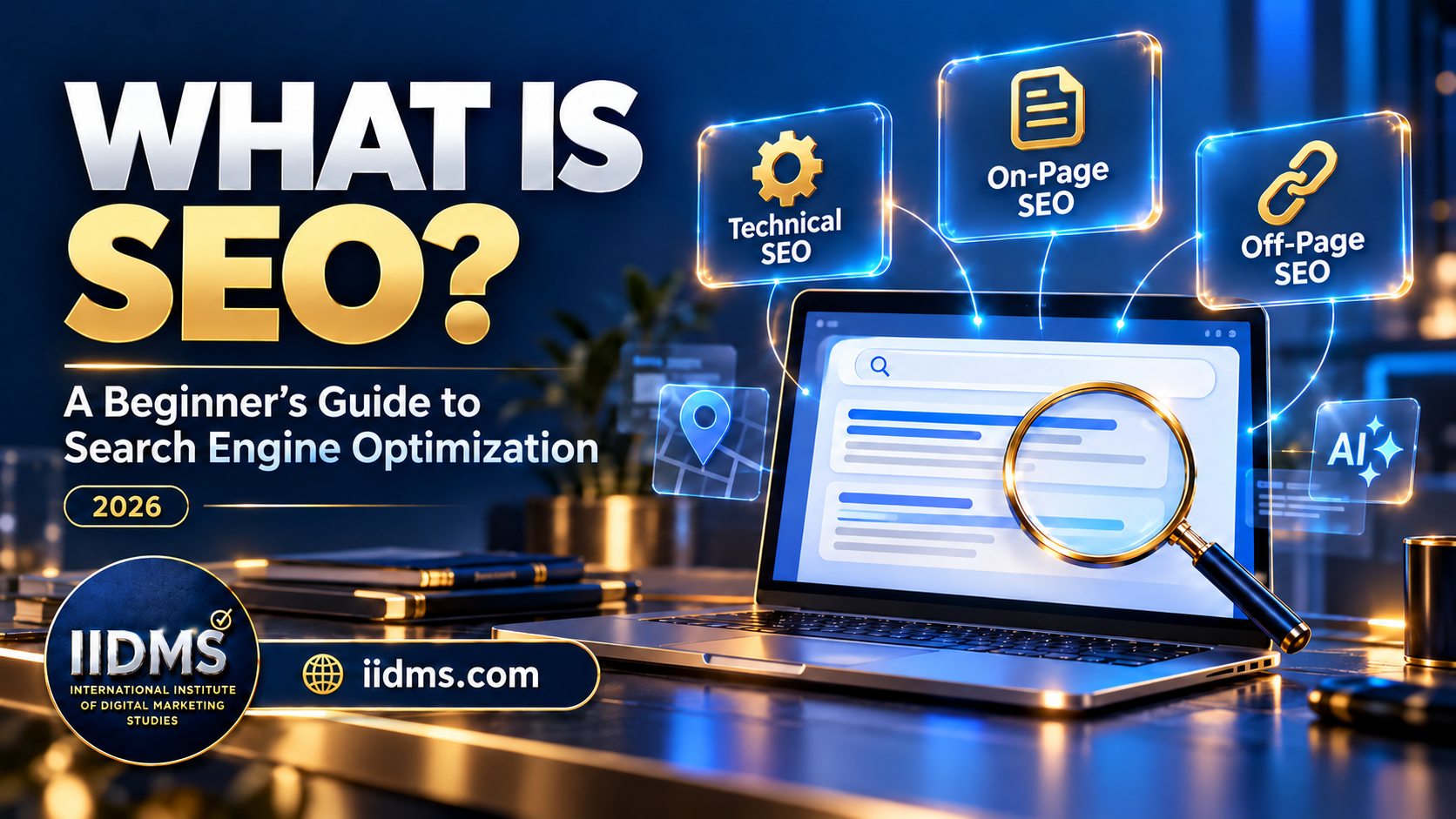
The Three Main Areas of SEO
1. Technical SEO
Technical SEO makes sure search engines can access, render and understand your site, and that visitors have a fast, stable experience.
- Crawlability: a clean XML sitemap, a sensible robots.txt and no important pages hidden behind logins.
- Indexing control: one version of each page. Redirect duplicates such as www and non-www, use canonical tags, and noindex thin pages such as internal search results.
- Speed and stability: aim for "good" Core Web Vitals. Compress images, limit heavy scripts and reserve space for images and ads.
- Mobile first: Google mainly uses the mobile version of your pages, so test every template on a phone.
- Security: HTTPS everywhere, and no debug information or private files left publicly accessible.
- Structured data: schema markup, for example Organization, Course, Article, FAQ and LocalBusiness, helps search engines understand your content.
2. On-page SEO and content
On-page SEO matches each page to what people are searching for and makes the content genuinely helpful.
- One main topic per page, chosen through keyword research, with one clear H1.
- Title tags of roughly 50 to 60 characters that include the main keyword and a reason to click.
- Meta descriptions of roughly 120 to 158 characters that summarise the page. They do not directly affect ranking but influence clicks.
- Logical headings (H2, H3) so readers and search engines can scan the page.
- Internal links between related pages using descriptive anchor text, so authority and visitors flow through the site.
- Images with descriptive file names and alt text.
- Experience and expertise: real examples, original data, clear authorship and up-to-date facts. Google's guidance calls this people-first content, often summarised as E-E-A-T (experience, expertise, authoritativeness and trust).
AI tools can speed up research and drafting, but every page still needs human review for accuracy and originality. See how to use generative AI responsibly and how to write AI prompts for marketing.
3. Off-page SEO
Off-page SEO builds your site's reputation across the web.
- Backlinks from relevant, trusted websites, earned through useful content, partnerships, media mentions and industry directories.
- Brand mentions and citations that consistently show your business name, address and phone number.
- Reviews on Google and other platforms, especially for local businesses.
Avoid buying links or joining link schemes. Google's spam policies treat them as manipulation, and they can harm rankings.
Local SEO
For any business that serves customers in a specific area, local SEO is often the quickest win: a complete Google Business Profile, accurate details, the right categories, photos, regular updates and genuine reviews. Follow our local SEO checklist for the Dubai Google Map Pack step by step.
SEO in the Age of AI Overviews
Google now shows AI-generated summaries, called AI Overviews, above many results. With 2 billion monthly users, they change how people see search results: some simple questions are answered directly, while links to sources appear inside the summary.
- Be the source: clear definitions, original data, step-by-step answers and well-structured pages are easier for AI systems to quote and link to.
- Answer the follow-up questions: cover a topic in depth, then link to detailed pages. This is called building topical authority.
- Strengthen your brand: searches for your brand name and positive mentions matter more as answers become more summarised.
- Measure beyond clicks: watch impressions in Google Search Console as well as clicks, leads and conversions.
Read more in digital marketing and AI automation trends for 2026.
SEO vs Paid Search (PPC)
| Area | SEO | Paid search (PPC) |
|---|---|---|
| Cost per click | Free | You pay for each click |
| Speed | Months to build | Traffic from the first day |
| Durability | Keeps working after the work is done, if maintained | Stops when the budget stops |
| Trust | Organic results are often trusted more | Clearly labelled as sponsored |
| Best use | Long-term growth, education and authority | Fast leads, testing offers, seasonal campaigns |
Most businesses do best with both: paid search for quick results while SEO builds. Compare the paid options in Google Ads vs Meta Ads for lead generation.
How to Do Keyword Research
- List your topics. Write down your products, services and the questions customers ask your sales team.
- Find search terms. Use Google Keyword Planner, Google's autocomplete and "People also ask" boxes, and the queries already shown in Search Console.
- Check intent. Search each term and look at what ranks: guides (informational), comparisons (commercial) or service pages (transactional). Match that format.
- Add location where relevant, for example "digital marketing course Dubai" or "online in the UAE".
- Prioritise. Start with specific, lower-competition terms that are close to a sale, then build towards broader terms.
- Map one main keyword per page to avoid several of your pages competing with each other.
SEO Checklist for Beginners
| Step | Task | Free tool |
|---|---|---|
| 1 | Verify your site and submit an XML sitemap | Google Search Console |
| 2 | Set up analytics and conversion tracking | Google Analytics 4 |
| 3 | Fix duplicate versions with redirects and canonical tags | Search Console URL Inspection |
| 4 | Check speed and Core Web Vitals on mobile | PageSpeed Insights |
| 5 | Write a unique title, meta description and H1 for every key page | Your CMS |
| 6 | Research keywords and map one per page | Google Keyword Planner |
| 7 | Publish helpful content that answers real questions | Search Console queries |
| 8 | Link related pages together | Your CMS |
| 9 | Add structured data and test it | Rich Results Test |
| 10 | Complete your business profile and ask for genuine reviews | Google Business Profile |
SEO Metrics to Track
- Impressions and clicks from Google Search Console, by page and by query.
- Average position for your priority keywords, judged as a trend rather than day to day.
- Click-through rate, which shows whether titles and descriptions attract clicks.
- Indexed pages and any errors in the Search Console Pages report.
- Organic conversions in GA4: enquiries, sign-ups and sales from organic search.
Common SEO Mistakes to Avoid
- Several pages with the same title, or "Home" as the title on every page.
- Duplicate versions of the site, such as www and non-www, or http and https, without redirects.
- Thin pages with little useful content, or many near-identical location pages.
- Publishing unedited AI text with errors or no original value.
- Buying links or using keyword stuffing.
- Large, uncompressed images that slow down mobile pages.
- Leaving private files, backups or debug details publicly accessible.
How to Learn SEO
SEO is learned best by doing: auditing a real site, researching keywords, writing pages and watching the data change in Search Console. IIDMS programmes are available live online or as self-paced study for learners across the UAE and GCC.
| Your goal | Programme |
|---|---|
| Specialise in SEO | Certified SEO Professional |
| Learn SEO as part of a complete digital marketing skill set | Certified Digital Marketing Master with Generative AI |
| Write content that ranks and converts | Certified Content Marketing Professional |
| Combine SEO with paid search | Certified Pay-Per-Click (PPC) Advertising |
Comparing options? Read is a digital marketing certification worth it? and what top AI marketing courses teach.
Frequently Asked Questions
How long does SEO take to work?
Quick technical fixes and local SEO improvements can show results within weeks. Ranking for competitive terms usually takes several months of consistent work on content, links and site quality.
Is SEO still worth it with AI search?
Yes. AI Overviews and assistants still rely on web pages as sources, and Google remains the main way people in the UAE find businesses. The focus shifts towards being the most helpful, trustworthy source on your topics.
What is the difference between SEO and SEM?
SEO earns unpaid visibility in search results. SEM (search engine marketing) usually refers to paid search ads, and sometimes to SEO and paid search together.
Can I do SEO myself?
Yes. Many basics, such as Search Console, titles, content, internal links and your business profile, can be done without coding. Technical issues on larger sites may need a developer.
Does social media help SEO?
Social signals are not a direct ranking factor, but social media spreads your content, which can earn links, brand searches and visits. See how to choose the right social media platforms.
Final Thoughts
SEO rewards websites that are easy to crawl, clearly organised and genuinely helpful. Fix the technical basics, publish content that answers real questions, link it together and earn trust over time. That combination keeps working even as AI changes how results look.
Ready to build real SEO skills? Explore the Certified SEO Professional programme or read our guide to digital marketing strategy for UAE businesses.
Sources
- StatCounter Global Stats, "Search Engine Market Share United Arab Emirates": gs.statcounter.com
- TechCrunch, "Google's AI Overviews have 2B monthly users, AI Mode 100M in the US and India" (23 July 2025): techcrunch.com
- Google Search Central, "In-depth guide to how Google Search works": developers.google.com
- web.dev, "Web Vitals": web.dev