Search for "AI marketing course" and you will find hundreds of options, from free one-hour videos to long certifications. Most promise to make you "AI-ready". Far fewer show you how to use AI on the real work of a marketing team: writing better briefs, producing content faster, predicting which leads and customers matter, and improving campaigns while they run.
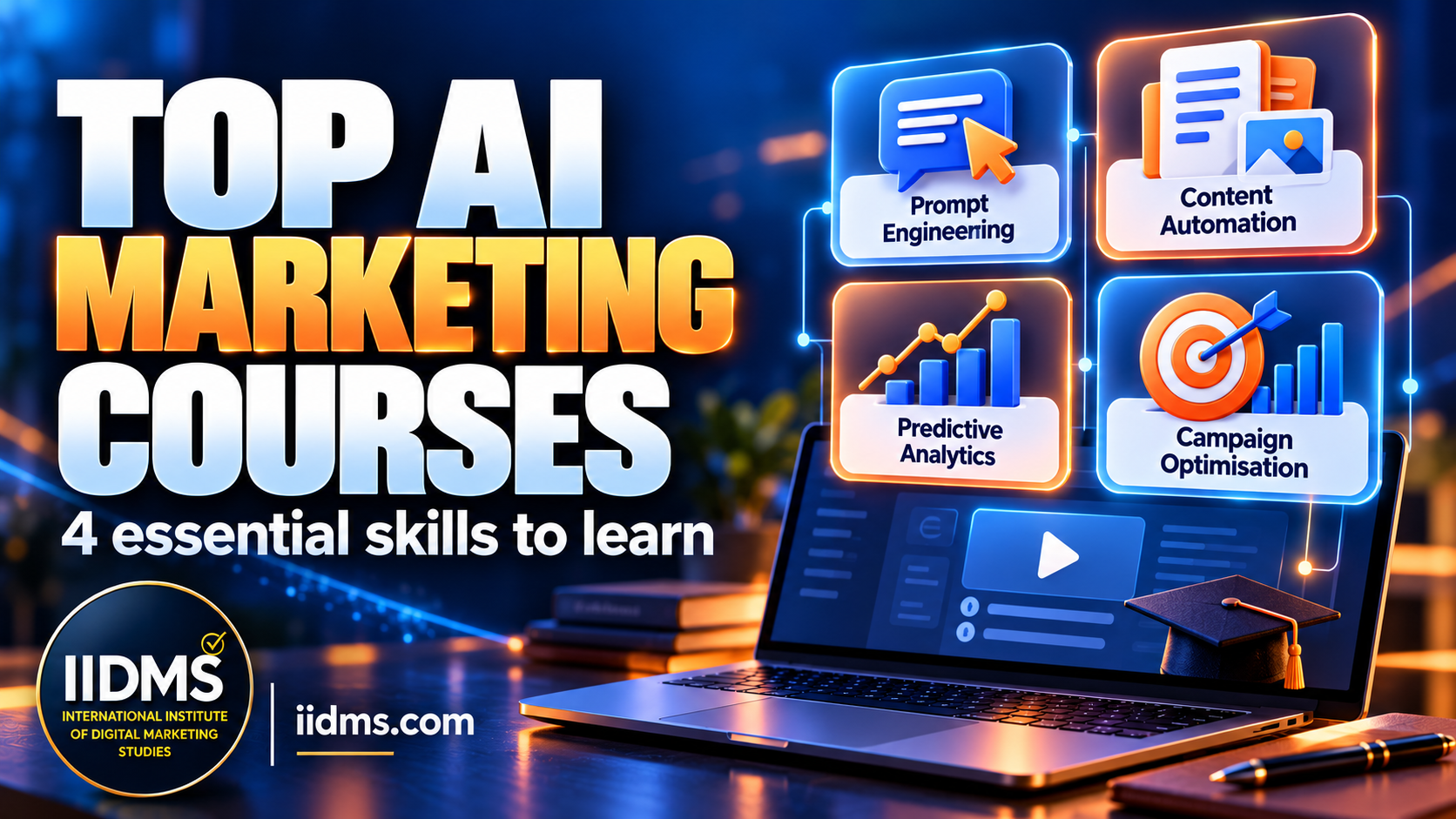
This guide explains what the top AI marketing courses actually teach across four skill areas: prompt engineering, content automation, predictive analytics and campaign optimisation. It also covers what to expect in each, a checklist for comparing courses, and how to choose a programme that fits your goals in the UAE and GCC. All statistics are taken from the sources listed at the end.
Why AI Marketing Skills Are Now Expected
AI is no longer an experiment in most marketing teams. The question employers ask has shifted from "have you tried AI?" to "can you use it well, safely and measurably?"
| Finding | Figure | Source |
|---|---|---|
| Marketers actively deploying generative AI | 85% (up from 75% in 2024) | SAS & Coleman Parkes, Sept 2025 (300 organisations) |
| Marketers using at least one form of AI (predictive, generative or agentic) | 76% | Salesforce State of Marketing, 10th edition (4,450 marketers, 26 countries) |
| Teams using AI that report at least one data barrier to personalisation | 98% | Salesforce State of Marketing, 10th edition |
| Growth in UAE LinkedIn members adding AI skills to their profiles | 80x, the highest of any country listed | LinkedIn Skills on the Rise 2025, via Gulf News |
| AI literacy and prompt engineering on LinkedIn's fastest-growing skills list | #9 and #13 of 15 | LinkedIn Skills on the Rise 2025 |
| Average uplift for advertisers using Performance Max well | 18% more incremental conversions at a similar cost per action | Google (Google data, Nov–Dec 2022; results vary) |
Two lessons stand out. First, adoption is already high, so basic tool familiarity is not a differentiator. Second, the 98% data-barrier figure shows where most teams struggle: connecting AI to good data and turning it into results. That is exactly what a good course should train.
The Four Skill Areas a Top AI Marketing Course Should Cover
| Skill area | What you should be able to do after the course | Typical tools |
|---|---|---|
| Prompt engineering | Write structured prompts with role, context, task, format and constraints; build reusable prompt templates; check output for accuracy and brand voice | ChatGPT, Claude, Gemini, Copilot |
| Content automation | Turn one brief into blogs, social posts, emails and ad variations; automate repetitive steps with an approval stage before anything is published | AI assistants, Canva, Zapier or Make, scheduling tools |
| Predictive analytics | Understand lead scoring, churn and purchase-propensity signals; use GA4 and CRM data to decide who to target and when | GA4, CRM lead scoring, spreadsheets with AI analysis |
| Campaign optimisation | Set up and improve AI-driven campaigns, feed them good conversion data and creative, and read results correctly | Google Ads (Performance Max, Smart Bidding), Meta Advantage+ |
1. Practical prompt engineering
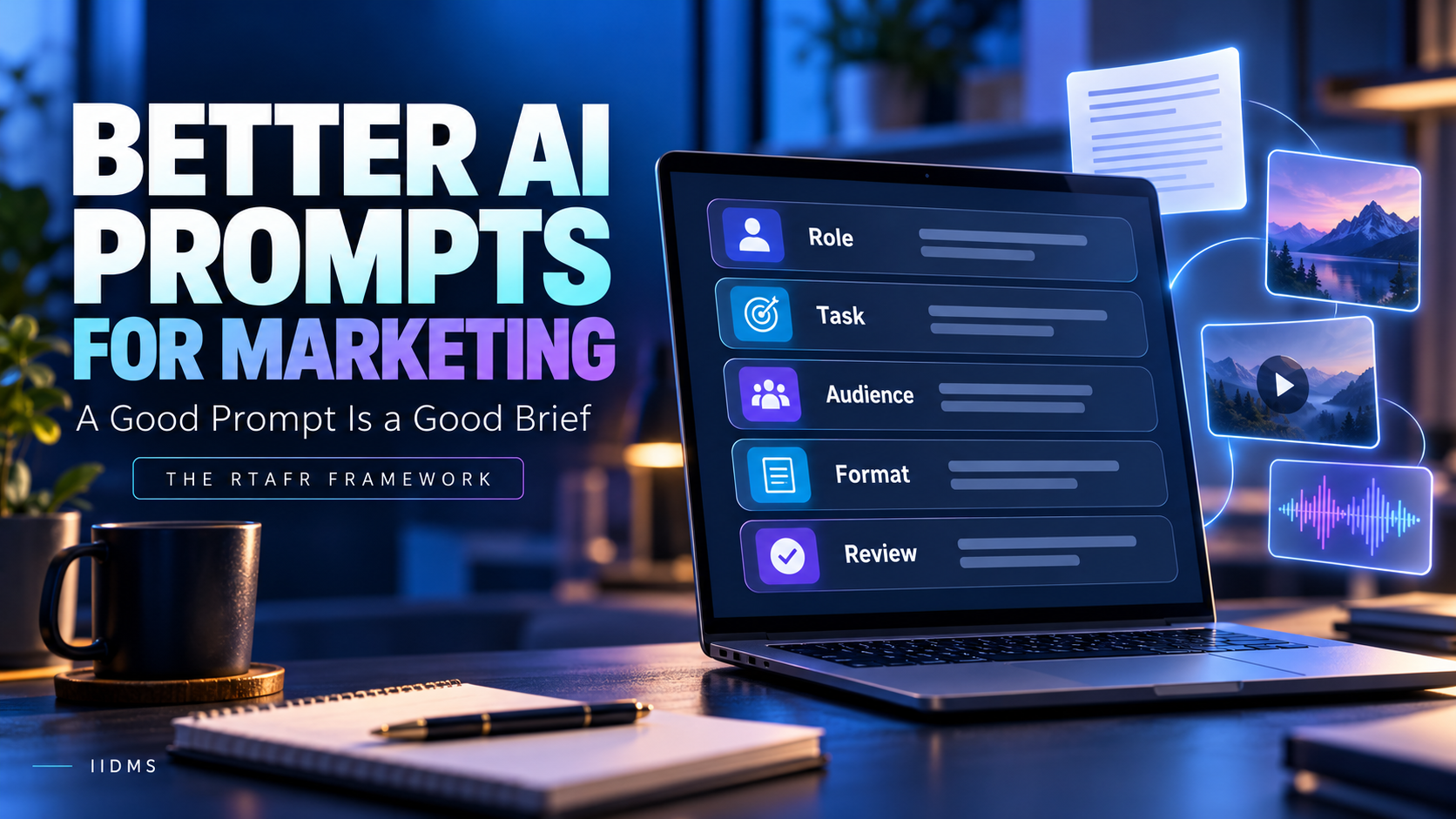
Prompt engineering is the foundation, because every other AI skill depends on giving clear instructions. A good course goes beyond "act as a marketer". It should teach you to:
- Structure prompts with role, context, task, format and constraints, and include real examples of your brand voice.
- Break big jobs into steps (research, outline, draft, edit) instead of asking for everything at once.
- Build a reusable prompt library for recurring tasks such as ad copy, briefs, reports and replies.
- Check every output for facts, tone, compliance and originality before it is used.
For ready-to-use templates, see our guide on how to write AI prompts for marketing.
2. Content automation
Content automation means producing more useful content with less repetitive effort, without losing quality. In a strong course you practise:
- Repurposing workflows: one webinar or article becomes a blog post, LinkedIn carousel, short-video script, email and ad variations.
- Connected tools: linking AI assistants with design, scheduling and automation tools so drafts move to the right place automatically.
- Human approval: building a review step into every workflow, so nothing is published without a person checking it.
- Responsible use: disclosure, copyright, data privacy and keeping client information out of public tools.
Read more in how marketers can use generative AI responsibly, and see real tools in action in new Claude AI features for marketers.
3. Predictive analytics
Predictive analytics uses past data to estimate what is likely to happen next: which leads are most likely to buy, which customers may stop buying, and which audiences will respond. You do not need to become a data scientist, but you should be able to:
- Understand how lead scoring and propensity models work, and what data they need.
- Use GA4 and CRM reports to spot patterns, and use AI to summarise and question the data.
- Decide budgets, audiences and follow-up priorities based on predicted value, not just volume.
- Recognise poor data (missing conversions, duplicate leads, wrong tracking) that makes predictions unreliable.
This is where many teams fall short. Salesforce found that almost every team using AI meets at least one data barrier, so practical training in clean tracking and data use is a real advantage.
4. Campaign optimisation with AI
Google and Meta now run much of their bidding, targeting and creative selection with AI. Google reports that advertisers making the most of Performance Max see an average of 18% more incremental conversions at a similar cost per action. The key word is "making the most of", because results depend on the inputs you give the system. A good course teaches you to:
- Set up accurate conversion tracking and import offline conversions, such as qualified leads from your CRM.
- Supply strong creative assets, audience signals and landing pages, which AI campaigns depend on.
- Choose the right bid strategy (for example target CPA or target ROAS) and give it enough time and data to learn.
- Read results honestly: incremental results, lead quality and cost per qualified lead, not just clicks.
Compare the two biggest platforms in Google Ads vs Meta Ads for lead generation.
Basic vs Top AI Marketing Course: What to Compare
| Area | Basic course | Top course |
|---|---|---|
| Prompt engineering | Lists of "magic prompts" | A prompt method, templates for real tasks, and output review |
| Content | Generates single posts | End-to-end workflows with automation and approval steps |
| Data | Not covered | GA4, CRM data, lead scoring and tracking quality |
| Ads | Theory only | Hands-on Google and Meta campaigns with AI bidding |
| Ethics and privacy | A short mention | Clear rules for data, disclosure and brand safety |
| Proof of skill | Certificate only | A real project or portfolio piece reviewed by a trainer |
| Support | Recorded videos only | Live online sessions or guided self-paced study with trainer feedback |
Checklist: How to Choose an AI Marketing Course
- Look at the syllabus, not the title. Check that all four skill areas are covered, with time for practice.
- Ask what you will build. A campaign, a content system or a dashboard is worth more to employers than a quiz score.
- Check the tools. The course should use the tools teams actually use (Google Ads, Meta Ads Manager, GA4 and current AI assistants), with the content kept up to date.
- Check who teaches it. Look for trainers who run real campaigns, and for feedback on your own work.
- Match the format to your life. Live online classes suit people who want structure; self-paced study suits busy professionals across the GCC.
- Look for responsible-AI content. Data privacy, accuracy checks and disclosure are now part of the job.
- Compare the credential. Check what the certificate is, who recognises it, and whether it shows practical ability. Our guide is a digital marketing certification worth it? explains what to look for.
Which IIDMS Programme Fits Your Goal?
IIDMS programmes are taught live online or as self-paced study, so learners anywhere in the UAE and GCC can join. Use this table as a starting point, and check each course page for the current syllabus.
| Your goal | Suggested programme |
|---|---|
| A complete career in digital marketing with AI built in, covering strategy, content, social, SEO and paid ads | Certified Digital Marketing Master with Generative AI |
| Hands-on AI automation and workflows for marketing and business tasks | Certified Applied Generative AI Automation Professional (CAGAP) |
| A practical, shorter route into digital marketing with generative AI | CDMP: Certified Digital Marketing Practitioner with Generative AI |
| Running and optimising Google and Meta campaigns | Certified Pay-Per-Click (PPC) Advertising |
| Content systems and AI-assisted writing | Certified Content Marketing Professional |
| Leading AI adoption and digital strategy as a manager | Certified Executive in Digital Strategy & AI Leadership (DSAIL) |
Not sure which suits you? Read about the Certified Digital Marketing Master with Generative AI and the CAGAP automation course, or watch our free AI-powered digital marketing webinar to see the teaching style. You can also browse all IIDMS courses.
Frequently Asked Questions
Do I need coding skills for an AI marketing course?
No. Prompt engineering, content automation and campaign optimisation use no-code tools. Predictive analytics in a marketing course focuses on using and interpreting data in GA4, CRMs and ad platforms, not on building models.
How long does it take to learn AI for marketing?
You can learn useful prompting in a few days of practice. Building reliable content workflows, using data well and optimising campaigns takes longer, because you need to apply them to real projects. That is why structured programmes with assignments work better than short videos alone.
Will AI replace digital marketers?
AI is changing marketing tasks, but businesses still need people who set strategy, judge quality, protect the brand and own the results. Marketers who can direct AI tools well are in a stronger position. See digital marketing and AI automation trends for 2026.
Which is better: a free AI course or a certification?
Free courses are useful for learning a single tool. A certification is worth it when it includes a full syllabus, trainer feedback and a practical project that proves your ability to employers.
Final Thoughts
The best AI marketing courses do not teach tricks. They build four working skills: clear prompting, automated content with human review, data-driven decisions and AI-powered campaign optimisation. Choose a course that makes you practise all four on real work, and you will be ready for the way marketing teams in the UAE, the GCC and beyond now operate.
Ready to start? Explore the Certified Digital Marketing Master with Generative AI or speak to our admissions team.
Sources
- SAS, "New study: GenAI hype is over as 93% of CMOs see strong ROI" (SAS and Coleman Parkes, September 2025): sas.com
- Salesforce State of Marketing, 10th edition, as reported by diginomica: diginomica.com
- LinkedIn Skills on the Rise 2025, as reported by Gulf News: gulfnews.com
- Google, "Benefits of Performance Max": business.google.com